
nineteen miles down the road...
Many Americans, and many local residents in my community are familiar with the pictures. But not familiar with the facts surrounding this heinous racially motivated event.

I live in a small rural community located in the northeast section of Indiana. Just miles from the headwaters of the Wabash River. An area deep in historical significance. Where the Miami and Potawatomi called home and still do. Where the Wabash/Erie Canal once made its way through. A community recognized by many as the First Electrical Lighted City in the World, a claim that has been debated and questioned by many outsiders. But never by the locals.
There are an estimated10k residents within city limits, and about 29K county wide. We are considered a media desert.
It is a community that is 94.5% white. A community that voted 75% republican in the last presidential election. It is a rural community that has a large part of its population rooted in conservative ideologies. To say that Christian Nationalism is alive in our community would be an understatement. It is not only alive but also thriving.
Indiana has a long history of this type of ideology, this type of racism. At one point we had one of the highest concentrations of Sundown Towns in the country. Rivaling States like Mississippi and Alabama. Even the community that I was born and raised in was once listed as a Sundown Town. As were other surrounding communities.
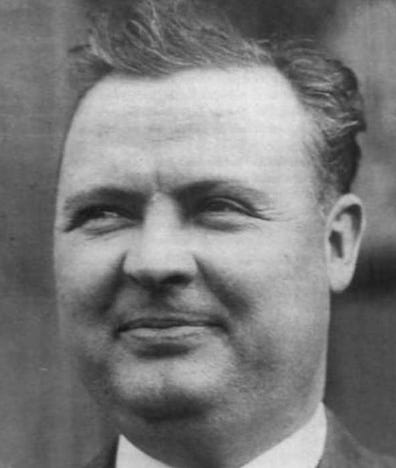
The presence of the KKK has been a constant in Indiana since the rise of its popularity in the 1920’s mainly due to D.C. Stephenson, who in 1922 was appointed the Grand Dragon of the Indiana Ku Klux Kaln and 22 other Northern States after he backed Hiram Evans in his successful appointment as the Imperial Wizard of the National Klan. Under Stephenson’s leadership, the Klan’s membership grew to over 250,000 members with close to 30% of Indiana white males as members. His reign was cut short due to his conviction of the murder of Madge Oberholtzer in 1925. The popularity of the Klan is once again on the rise in Indiana. Although, it never went away.
My hometown is Historically Ranked as the 27th highest in the state for Klansmen per capita. But just nineteen miles down the road…is the city of Marion. It is the largest city in population with the highest ranking of Klansmen per capita, with two known Klan Chapters within the community.
This is where my story travels. Nineteen miles down the road…
On of the most famous or should I say infamous photos of a lynching that took place in America, that people are widely familiar with is that of a lynching that took place in Marion, Indiana.
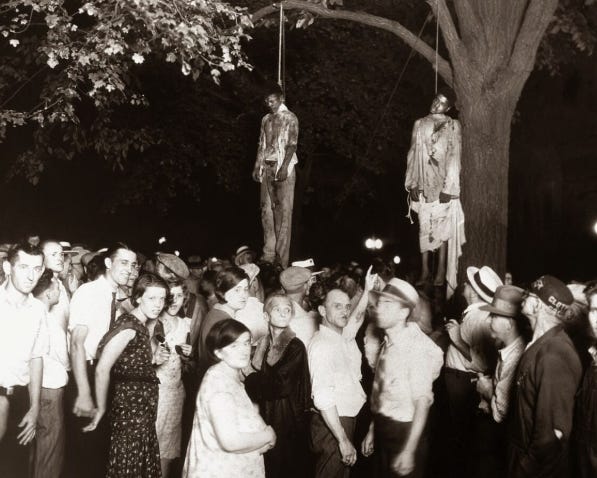
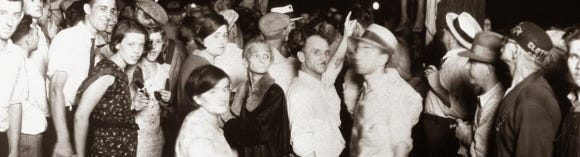
On August 7th, 1930, three black teenagers, Thomas Shipp (19), Abram Smith (19), and James Cameron (16) had been wrongly accused, arrested, and jailed for the murder of a White man by the name of Claude Deeter, and the rape of a White woman named Mary Ball. Before they could stand trial, which would have no doubt been a biased railroading of these three young men. An angry mob, led by known Klansmen, amongst other racist white residents, stormed the Grant County Jail. At around 9:30 pm, reports of a mob crowd in excess of over 5,000 attempted to break into the jail. Initially they were repelled by tear gas, less than an hour later they were successful at overrunning the Sheriff and three deputies. Local Newspapers reported that the resistance from law enforcement at that point was nonexistent. The mob grabbed Thomas and Abram from their cells, who were reported to be praying, dragged them into the street. Amidst cheers from the mob the two young men were beaten, tortured, mutilated, and both men were hanged from the trees in the courthouse lawn. No trial and no proof of these young men ever committing these crimes was ever presented or brought forth.
A Podiatrist, Dr. E. Frank Turner from Muncie, Indiana, a neighboring city, showed up at the Jail around 8:00 pm. when he heard of the events that were taking place. He left after hearing that water would be used to disperse the crowd. He left thinking that everything would be all right. He later returned around 10:00 pm. After hearing the mob was still present. He arrived at the precise moment to witness the mob dragging, beating, and hanging Thomas and Abram. Dr. Turner later recalled:
The bodies went up, dangling on the rope, and a demoniacal yell surged from the crowd. It was hideous! That mob sounded like wild wolves; the yells were more like vicious snarls. Some even clapped their hands.
While Thomas and Abram hung from the tress, the mob reentered the jail and took James from his cell. The mob severely beat the teenager and was preparing to hang him when someone in the crowd yelled out that James was innocent. He was returned to his cell and awaited trial that occurred a year later. He was charged and convicted as an accessory before the fact to voluntary manslaughter. He served Four years in prison. He was paroled in 1935.
The brutalized bodies of Mr. Shipp and Mr. Smith hanging from trees in the courthouse yard were kept there on display for hours. It is said the mob size swelled to nearly 10,000 to view the horrendous spectacle. It was common for crowds of White Folk to gather in large numbers to witness and participate in pre-planned heinous killings that featured prolonged torture, mutilation, dismemberment, and/or burning of Black victims. Who were never guilty of any crime, except for being born Black. When the sheriff eventually cut the ropes off the corpses, the crowd rushed forward to take parts of the men’s bodies as “souvenirs” before finally dispersing.
After his release, James Cameron survived the brutal attack. An experience that haunted him his entire life. He went on to find four NAACP chapters in Indiana, authored hundreds of essays on civil rights and a 1982 memoir. On Juneteenth 1988 he opened America’s Black Holocaust Museum in Milwaukee, Wisconsin, to document the African American Struggle. “I can forgive but I can never forget,” he was quoted as saying. “That’s why I started this museum.” Mr. Cameron was pardoned by the state of Indiana in 1993 and died in 2006.
In 1937, an encounter with the photo inspired New York schoolteacher Abel Meeropol to write “Strange Fruit,” a haunting poem about lynching that later became a famous song recorded by Billie Holiday.
Being the historical nerd that I am, I have always known that Indiana, and my community, has long been embroiled in racism and a major player in the presence of the KKK. It is a part of our past and our present that leaves me with disgust and shame knowing that the community, the State I love, and call home has made this mark in American History. I sometimes wonder though how many other Hoosiers are aware of the facts that surround Indiana’s place in the promotion and acceptance of racial hatred and white supremacy.
I am sure that most Americans think that the Lynchings of innocent Black people only occurred in the South. I am also sure that most of them are unaware that one of the most famous photos that documented, one of the most violent of unlawful Lynchings in American History. Occurred here in the North.
Nineteen miles down the road…